

How to Use Generative AI to Drive Innovation in Your Industry
Most organisations are using generative AI. Most are not innovating with it. 66% of organisations report productivity or efficiency gains from generative AI — but only 20% report revenue gains, and more than 80% report no measurable enterprise-level EBIT impact. The technology is not the problem. The gap between access and application is. This guide explains what generative AI actually is, how it is being used across industries to drive real innovation, and what it takes to move from experimentation to execution.
Key Takeaways
- Generative AI reached 53% population adoption within three years — faster than the PC or the internet.
- 79% of businesses are using generative AI as part of their workflow — but only 36% of executives report scaling it, and just 13% report meaningful enterprise-wide impact.
- The gap between using generative AI and innovating with it is not a tool problem — it is a capability and implementation problem.
- Generative AI creates entirely new content from learned patterns. Understanding what it is — and what it is not — is the foundation of using it strategically.
- Innovation with generative AI requires workflow redesign, not just tool adoption.
What Is Generative AI? A Clear Introduction
Generative AI is a category of artificial intelligence that creates new content — text, images, code, audio, video, or synthetic data — by learning patterns from large datasets and generating outputs that match those patterns. It does not retrieve or copy existing information. It generates something new, based on what it has learned.
The key distinction from earlier AI systems is this: traditional AI was built to recognise and classify. Generative AI is built to create.
| Feature | Traditional AI | Generative AI |
| Primary function | Analyse, classify, predict | Create, generate, synthesise |
| Input | Structured data, labels | Natural language, images, prompts |
| Output | Category, score, decision | Text, image, code, audio, video |
| Examples | Fraud detection, spam filters, recommendation engines | ChatGPT, DALL-E, GitHub Copilot, Sora |
| Innovation role | Optimises existing processes | Creates new outputs and possibilities |
Understanding this distinction matters practically. When organisations use generative AI to optimise a process that already exists — summarising documents, reformatting reports, drafting standard emails — they are using it for efficiency. When they use it to create something that did not exist before — a new product concept, a personalised customer experience, a novel research synthesis — they are using it for innovation. Both are valuable. Only the second is transformative.
The 7 Types of Artificial Intelligence
Generative AI does not exist in isolation. It is one category within a broader taxonomy of artificial intelligence. Understanding where it sits helps organisations make better decisions about which type of AI applies to which problem.
| Type | What It Does | Example |
| Reactive AI | Responds to inputs with fixed rules, no memory | Chess engines, spam filters |
| Limited Memory AI | Learns from historical data to make predictions | Self-driving cars, recommendation engines |
| Theory of Mind AI | Understands human emotions and intent (in development) | Advanced conversational AI — not yet mature |
| Self-Aware AI | Possesses consciousness and self-understanding | Theoretical — does not exist |
| Narrow AI | Highly capable within one specific domain | All AI in use today, including generative AI |
| General AI (AGI) | Matches human cognition across all domains | Not yet achieved |
| Generative AI | Creates new content from learned patterns | ChatGPT, Gemini, DALL-E, GitHub Copilot |
All generative AI tools available today — including ChatGPT, Claude, Gemini, and Midjourney — are technically Narrow AI operating within the Limited Memory category. They are capable within their domain of content generation, but they are not general intelligences. Understanding this prevents both overestimation and underestimation. See all seven explained in our guide to types of AI.
Generative AI vs Agentic AI
As organisations mature in their use of generative AI, they will increasingly encounter agentic AI — and the two are often confused.
Generative AI responds to a prompt and produces an output. A human initiates every interaction and reviews every result. Agentic AI receives a goal, plans the steps to achieve it, takes actions across systems, and completes a multi-step task with minimal human input along the way.
| Feature | Generative AI | Agentic AI |
| Input | A prompt | A goal or objective |
| Output | A generated response | A completed task |
| Human involvement | Every interaction | Goal-setting and oversight checkpoints |
| Actions | Generates content | Executes across systems |
| Example | ChatGPT writes a market analysis | An AI agent researches, writes, formats, and emails the analysis |
For most organisations in 2026, generative AI is the right starting point. It is accessible, governable, and well-understood. Agentic AI is the next layer — more powerful, more autonomous, and requiring significantly more governance infrastructure to deploy safely.
Generative AI Examples Across Industries
The most effective way to understand what generative AI makes possible is to look at how it is already being applied across sectors.
Healthcare
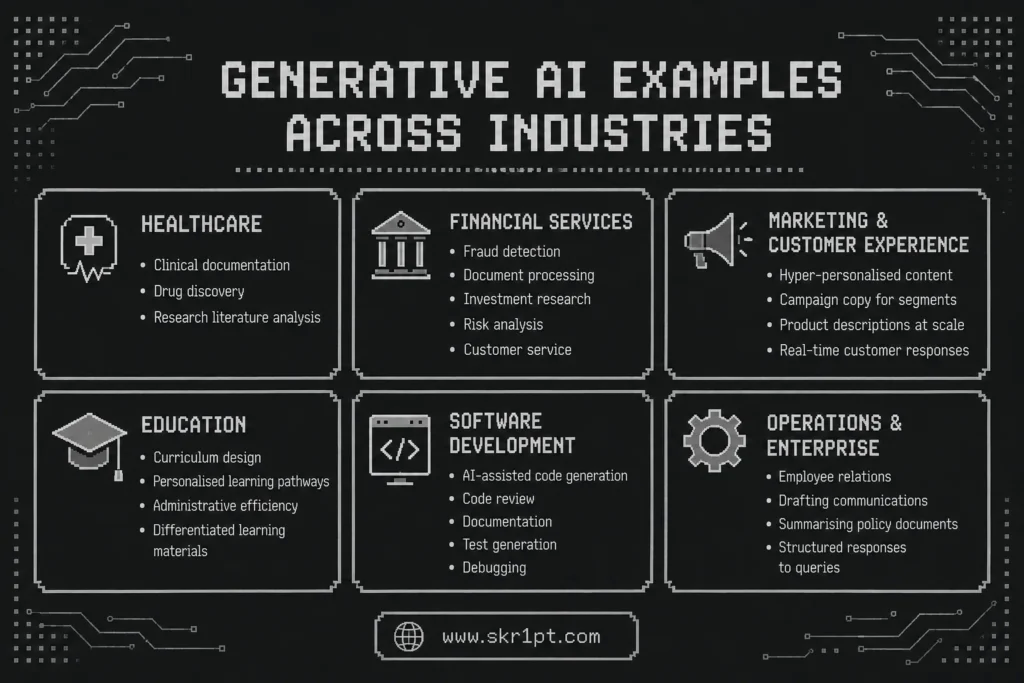
Generative AI is being used to assist in clinical documentation — automatically generating structured clinical notes from physician-patient conversations, reducing administrative time and improving record accuracy. It is also applied in drug discovery, generating candidate molecular structures and analysing research literature at a scale no human team could match. According to Mend, 100% of healthcare CIOs plan to implement AI by 2026, and 79% expect to adopt generative AI specifically.
Financial Services
Banks and financial institutions are deploying generative AI for fraud detection, document processing, investment research, risk analysis, and customer service. Lloyds Banking Group reported a £50 million gain from generative AI in 2025 and expects a £100 million benefit in 2026. The use cases are measurable, the data is structured, and the workflows are well-defined — conditions that make generative AI particularly effective.
Marketing and Customer Experience
75% of marketers have adopted AI, but 84% still say they run generic campaigns. The gap is not access — it is application. Generative AI enables hyper-personalised content at scale: campaign copy tailored to individual customer segments, product descriptions generated from structured data, and customer service responses drafted in real time.
Education
Generative AI is transforming curriculum design, personalised learning pathways, and administrative efficiency. Teachers are using it to generate differentiated learning materials for students with different needs. In Pakistan specifically, the application of generative AI to bridge gaps in teacher availability and learning quality is one of the most compelling near-term opportunities.
Software Development
GitHub Copilot and similar tools are reducing code-writing time significantly, with developers completing tasks faster when using AI assistance. Generative AI is also being used for code review, documentation, test generation, and debugging — compressing development cycles and reducing the cost of software production at scale.
Operations and Enterprise
Generative AI delivered the largest time savings in employee relations tasks at 49% — drafting communications, summarising policy documents, and generating structured responses to common queries.
The Top 5 Generative AI Tools in 2026
Understanding the tools is not the same as knowing how to use them strategically — but knowing the landscape is the starting point.
1. ChatGPT (OpenAI)
The most widely used generative AI tool globally. Strong across writing, research, coding, summarisation, and analysis. Best for: general-purpose professional tasks, content generation, and research synthesis.
2. Claude (Anthropic)
Known for accuracy, nuance, and strong performance on long documents and complex analysis. Best for: document-heavy roles, precise reasoning, and organisations with strict content governance requirements.
3. Gemini (Google)
Google’s flagship generative AI model, integrated into Google Workspace. Best for: organisations running on Google Workspace and teams that need AI embedded in existing workflows.
4. Microsoft Copilot
Embedded across Microsoft 365 — Word, Excel, Outlook, Teams, PowerPoint — Copilot reads your actual work context without requiring copy-pasting your data into a separate tool. Best for: Microsoft 365 organisations that want AI integrated into daily workflows with enterprise-grade security compliance.
5. GitHub Copilot
The leading generative AI tool for software development. Suggests code completions, generates entire functions, reviews pull requests, and answers coding questions in context. Best for: development teams looking to accelerate software production and reduce development overhead.
How to Actually Use Generative AI to Drive Innovation
Access to generative AI tools does not produce innovation. 84% of organisations have left jobs and workflows unchanged despite a 50% increase in worker access to generative AI during 2025. The organisations seeing transformative results are redesigning how work gets done — not just adding AI to the same processes.
The path from generative AI access to generative AI innovation follows a clear sequence:
Step 1 — Identify your highest-friction, highest-value workflows
Innovation with generative AI does not start with the technology — it starts with the problem. Which workflows consume the most time, produce the most inconsistency, or create the most friction for customers? Those are the candidates.
Step 2 — Map where generation replaces or augments human effort
Generative AI is most valuable where skilled human time is being consumed by creation tasks that follow patterns — writing, analysis, summarisation, drafting, formatting. Mapping exactly where this happens reveals the highest-leverage applications.
Step 3 — Build structured prompting and governance before scaling
Unstructured generative AI use produces uneven, ungoverned output. The organisations seeing measurable ROI have built prompt libraries, output review frameworks, and usage policies before scaling access across teams.
Step 4 — Redesign workflows, not just tasks
Adding ChatGPT to an existing workflow produces efficiency. Redesigning the workflow around generative AI capability produces innovation. The difference is whether you are using AI to do the same thing faster, or doing something the old workflow made impossible.
Step 5 — Measure and iterate
Define what success looks like before you start. Time saved, output quality, cost reduction, customer satisfaction — whatever the measure, define it, track it, and use it to iterate.
This is the approach skr1pt takes across every applied AI enablement engagement — building the structured capability, governance, and workflow design that turns generative AI access into measurable organisational value. If your organisation is ready to move from experimentation to execution, get in touch with skr1pt to start that conversation.
Conclusion
Generative AI is not a future technology — it is the defining business capability of 2026. The generative AI market grew from $44.89 billion in 2023 to $182 billion in 2026 — a 305% increase in three years. But market size does not determine organisational impact. The organisations that will build lasting competitive advantage from generative AI are those that pair tool access with structured capability, workflow redesign, and clear governance — not those that simply give their teams a subscription and wait.


3 Comments
Types of AI Explained: Reactive, Limited Memory & More
October 1, 2026[…] what type of AI powers ChatGPT, and most will shrug. Ask them the difference between a generative AI model and an AI agent, and the room goes quiet. This is not a small gap — it is the reason most […]
What Is Machine Learning? How It Works | skr1pt
October 2, 2026[…] Generative AI is an application of deep learning — systems that generate new content by learning patterns from training data. […]
What Is Deep Learning? A Beginner's Guide | skr1pt
October 2, 2026[…] the output, rather than processing data strictly in sequence. Used in: natural language processing, generative AI, code generation, multimodal […]