


What Is Deep Learning? A Beginner’s Guide
Every time you speak to a voice assistant, receive a product recommendation, or watch a self-driving car navigate traffic, deep learning is doing the work. It powers ChatGPT, Gemini, facial recognition, medical imaging analysis, real-time translation, and fraud detection at scale. The deep learning market grew from $34 billion in 2025 and is projected to reach $202 billion by 2030, driven by a technology that, despite being everywhere, most people still cannot explain. This guide does exactly that, without the jargon.
Key Takeaways
- Deep learning is a subset of machine learning that uses multi-layered neural networks to learn patterns from large amounts of data — without being explicitly programmed for each task.
- It is the technology behind ChatGPT, voice assistants, face recognition, medical imaging, and self-driving cars.
- Deep learning differs from traditional machine learning in one critical way: it learns its own features from raw data, rather than relying on humans to define what to look for.
- Neural networks account for nearly 57% of deep learning applications, and image recognition exceeds 33% of use cases.
- Understanding deep learning does not require coding — but it does require understanding what it can and cannot do, and why that matters for your work.
What Is Deep Learning in Artificial Intelligence?
Deep learning is a branch of machine learning — which is itself a branch of artificial intelligence. Understanding where it sits in the broader AI landscape helps clarify what it actually does.
Layer | What It Is | Example |
Artificial Intelligence | The broad field of machines performing tasks that require human-like intelligence | All AI systems |
Machine Learning | AI that learns from data to improve performance without being explicitly programmed | Spam filters, recommendation engines |
Deep Learning | Machine learning using multi-layered neural networks to learn complex patterns from raw data | ChatGPT, face recognition, self-driving cars |
The key word in the definition is deep — referring to the many layers in a neural network. Each layer processes the data in a progressively more abstract way. In an image recognition system, for example, the first layer might detect edges, the next detects shapes, the next identifies features like eyes or wheels, and the final layer classifies the whole image. No human told the system to look for edges or shapes. It learned to look for them on its own, by processing millions of examples.
That self-directed feature learning is what separates deep learning from earlier machine learning approaches — and what makes it so powerful for tasks involving language, images, audio, and video.
The Deep Learning Market in 2026
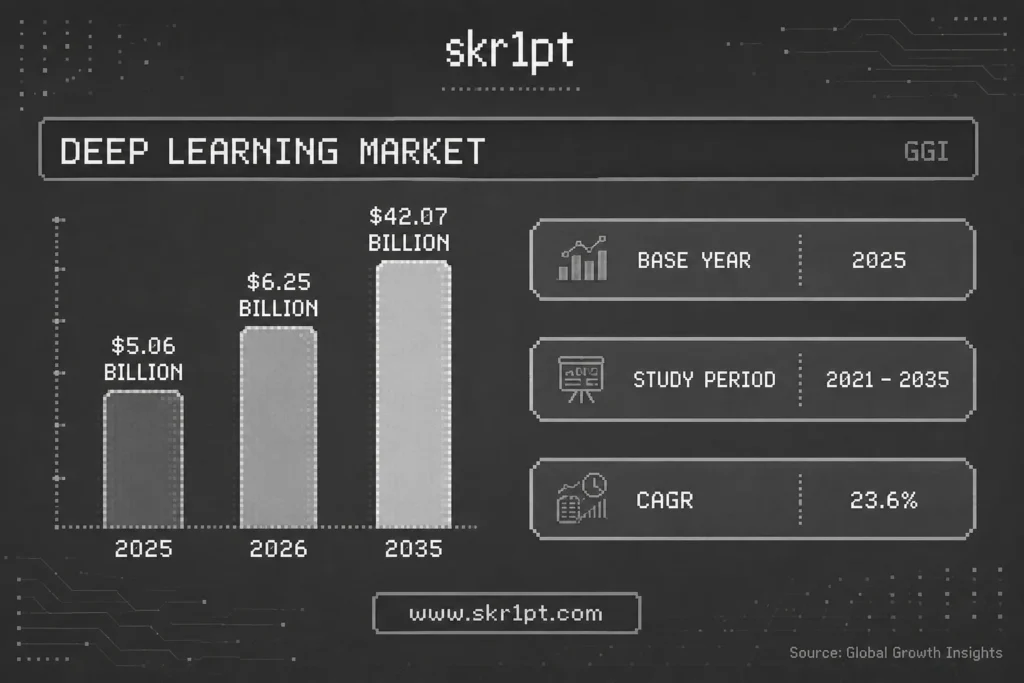
According to GII Research, the deep learning market was valued at approximately $47–64 billion in 2025–2026 and is projected to reach $296 billion by 2031, registering a CAGR of 35.48% — fuelled by large-scale investments in AI infrastructure, cloud computing advancements, and growing demand for AI automation across healthcare, automotive, finance, and retail. The growth trajectory reflects a fundamental shift in how organisations are using the technology: businesses are no longer asking only whether AI can perform a particular task — they are deciding where AI should be deployed, which models should be used, how inference costs can be reduced, and how AI workflows should be governed. According to a recent research by 9cv9, ay application, neural networks account for nearly 57% of deep learning use cases, image recognition exceeds 33% of applications, and cloud-based deployment dominates across sectors. Geographically, North America holds the largest market share at 38%, while Asia Pacific is projected to expand at the fastest rate during the forecast period. The sectors driving the most growth are healthcare, automotive, financial services, retail, and cybersecurity — each deploying deep learning not as an experiment, but as operational infrastructure. Growth drivers include increasing adoption of deep learning across industries, rising demand for real-time AI inference, expansion of edge AI deployments, growing investment in AI-driven automation, and increasing focus on explainable and efficient AI models.
How Deep Learning Actually Works
A deep learning model is built on a neural network — a system loosely inspired by how the human brain processes information. It consists of layers of interconnected nodes (called neurons), each of which receives inputs, performs a calculation, and passes an output to the next layer.
The three core components:
- Input layer — receives the raw data. For a language model, this might be words or tokens. For an image model, this might be pixel values.
- Hidden layers — the “deep” part. There can be dozens, hundreds, or even thousands of these layers in a modern deep learning model. Each layer applies mathematical transformations to the data, learning increasingly abstract representations. This is where the intelligence lives.
- Output layer — produces the result. A classification (is this a cat or a dog?), a generation (what word comes next?), a prediction (is this transaction fraudulent?), or a decision (should the car brake?).
How does it learn?
The model starts with random weights — essentially random guesses about how much each connection matters. It processes training data, compares its output to the correct answer, calculates the error, and adjusts the weights slightly to reduce that error. This process — called backpropagation — is repeated millions or billions of times across vast datasets until the model’s outputs are consistently accurate. The result is a model that has learned the patterns in the data, not because it was programmed with rules, but because it was exposed to enough examples to generalise.
Deep Learning vs Machine Learning
The terms are often used interchangeably. They should not be.
Feature | Traditional Machine Learning | Deep Learning |
Feature engineering | Human experts define what the model looks for | The model learns features automatically from raw data |
Data requirement | Works well with smaller, structured datasets | Requires large volumes of data to perform well |
Interpretability | More transparent — easier to explain decisions | Often a “black box” — harder to explain why it decided what it did |
Computational cost | Lower — can run on standard hardware | Higher — typically requires GPUs and significant compute |
Best for | Structured tabular data, smaller problems | Unstructured data (images, audio, text, video), complex pattern recognition |
Examples | Decision trees, linear regression, random forests | Neural networks, transformers, convolutional networks |
Traditional machine learning still has an important role — it is more interpretable, faster to train, and performs well on structured data. Deep learning is the right tool when the data is unstructured, the patterns are complex, and large amounts of training data are available.
Types of Deep Learning Models and Algorithms
Deep learning encompasses several distinct model architectures, each designed for different types of data and tasks.
Convolutional Neural Networks (CNNs)
Designed for image and video data. CNNs apply filters across an image to detect patterns — edges, textures, shapes, and eventually full objects. Used in: medical imaging, facial recognition, autonomous vehicles, quality inspection in manufacturing.
Recurrent Neural Networks (RNNs) and Long Short-Term Memory Networks (LSTMs)
Designed for sequential data — where order matters. RNNs process data step by step, maintaining a form of memory about what came before. Used in: speech recognition, time series forecasting, early language models.
Transformers
The architecture that powers all major large language models in 2026, including ChatGPT, Claude, and Gemini. Transformers use an attention mechanism — they learn which parts of the input are most relevant to the output, rather than processing data strictly in sequence. Used in: natural language processing, generative AI, code generation, multimodal AI.
Generative Adversarial Networks (GANs)
Two networks that compete — one generates content, one judges whether it is real or fake. Through competition, both improve. Used in: synthetic image generation, deepfakes, data augmentation, creative AI tools.
Autoencoders
Compress data into a smaller representation and then reconstruct it. Used in: anomaly detection, noise reduction, dimensionality reduction, recommendation systems.
Understanding which model type is appropriate for which problem is one of the most practically useful things a non-technical professional can take from a study of deep learning — because it informs which AI tools and vendors are actually suited to a given business need.
Real-World Deep Learning Examples
Deep learning is not a theoretical technology. It is commonly used in face recognition software, natural language processing, self-driving cars, language translation services, and speech synthesis software. Here is what that looks like in practice across sectors.
Healthcare
Deep learning models analyse medical images — X-rays, MRIs, CT scans — and identify patterns associated with diseases at a level of accuracy that matches or exceeds specialist clinicians. In radiology specifically, deep learning systems can detect early-stage cancers and flag anomalies for human review, dramatically compressing the time between scan and diagnosis.
Financial Services
Banks and financial institutions use deep learning for real-time fraud detection — analysing thousands of transaction variables simultaneously to flag unusual behaviour in milliseconds. Credit scoring models trained on deep learning can assess creditworthiness from a much wider range of signals than traditional models.
Natural Language Processing
Every large language model — ChatGPT, Claude, Gemini, Copilot — is built on deep learning, specifically the transformer architecture. The ability to understand context, generate coherent long-form text, translate between languages, and summarise complex documents all depends on deep learning models trained on billions of words.
Autonomous Vehicles
Self-driving systems use deep learning to process real-time video from cameras, interpret the environment, detect pedestrians and other vehicles, and make split-second driving decisions. Convolutional neural networks process the visual data; reinforcement learning models develop the decision-making policies.
Retail and E-commerce
Recommendation engines on platforms like Amazon, Netflix, and Spotify use deep learning to model individual preferences and predict what a user is likely to want next. These systems account for a significant share of total revenue on major platforms.
Voice Recognition
Every voice assistant — Siri, Alexa, Google Assistant — uses deep learning to convert speech to text, understand intent, and generate a spoken response. The accuracy of modern speech recognition is a direct product of transformer-based deep learning models trained on vast audio datasets.
How to Improve Your Deep Learning Skills
The most common mistake people make when approaching deep learning is starting with code before building conceptual understanding. Knowing how to run a model is less useful than knowing what the model is doing, why it works, and where it will fail. That conceptual layer is what determines whether someone can apply deep learning intelligently in their work — regardless of whether they write a single line of Python.
For non-technical professionals
The goal is not to build models — it is to understand what deep learning can and cannot do, how to evaluate AI tools and vendors that use it, and how to design workflows around it responsibly. The most valuable skill at this level is asking the right questions: What type of data does this model require? How was it trained? What are its known failure modes? Is there a human review step for high-stakes outputs?
For those building technical skills
Start with the mathematics before the code — linear algebra, calculus, and probability are the foundations. Then work through a structured learning path: understand neural networks conceptually, implement simple models in Python using frameworks like PyTorch or TensorFlow, work with real datasets, and move progressively toward more complex architectures. Practical projects on real problems produce faster skill development than passive coursework alone.
For organisations building deep learning capability
The bottleneck is rarely the model — it is the data quality, the governance framework, and the human capability to interpret and oversee model outputs. Organisations that build deep learning capability effectively invest as much in data infrastructure and human training as they do in model development.
This is the core of skr1pt’s applied AI enablement approach — building the structured understanding that allows individuals and organisations to use AI tools, including deep learning systems, with intention, governance, and accountability. If you are looking to build genuine AI capability in your team or institution, get in touch with skr1pt.
Conclusion
One of the most consequential deep learning trends in 2026 is the transition from experimentation to operational deployment — businesses are no longer asking only whether AI can perform a task, but where it should be deployed, which models should be used, and how AI workflows should be governed. Deep learning is the engine underneath that transition. Understanding what it is, how it works, and what it demands — from data, from infrastructure, and from the people using it — is no longer optional knowledge for professionals, educators, or leaders. It is the baseline.





1 Comment
What Is Machine Learning? How It Works | skr1pt
October 2, 2026[…] learning is frequently confused with artificial intelligence and deep learning. They are related but […]